Thursday, November 25, 2021

the other torah

I wonder if there has been much Islamic theological reflection on the Samaritans? In popular Western imagination (especially in the parable of the Good Samaritan) they are primarily imagined as a racial / ethnic group but they are also a religious group representing an alternate version of Abrahamic religion. They claim to be the children of Israel, but they have their own distinct version of the Torah and their central holy place is Mount Sinai rather than the Temple in Jerusalem.

One area where the Samaritans might be particularly interesting to Muslims is that their version of the Torah gives us a more concrete way to talk about Biblical corruption.

For example, consider Tablet magazine's article The Other Torah on differences between the Samaritan and Masoretic texts by Chaive Lieber. There are literally thousands of variations between the texts:

The 6,000 differences between the two Torahs [...] can be split into two categories: 3,000 of the differences are orthographical, meaning there are spelling differences or additional words placed in the text, while the other 3,000 are more significant in changing the Torah’s narrative.

Some of the orthographical changes help make the story read more smoothly. For example, in Genesis 4:8, when Cain talks to Abel, the Masoretic version reads, “Now Cain said to his brother Abel, while they were in the field, Cain attacked his brother Abel and killed him,” whereas the Samaritan Torah contains additional words: “Now Cain said to his brother Abel, ‘Let’s go out to the field.’ ”

The Samaritan Torah also offers a slightly different version of some stories. It includes parts of dialogues that are not found in the Masoretic text: For example, in Exodus chapters 7 through 11, the Samaritan Torah contains whole conversations between Moses, Aaron, and Pharaoh that the Masoretic text does not.

The other differences that are significant in narrative sometimes change the story, and sometimes “fix” small sentences that appear incoherent.

In Exodus 12:40, for example, the Masoretic text reads: “The length of the time the Israelites lived in Egypt was 430 years,” a sentence that has created massive chronological problems for Jewish historians, since there is no way to make the genealogies last that long. In the Samaritan version, however, the text reads: “The length of time the Israelites lived in Canaan and in Egypt was 430 years.”

[...]

Perhaps the most variant of texts within the two Torahs is the differences in the Ten Commandments.

“The Commandments are all in the form of ‘do’ and ‘don’t do,’ ” Tsedaka asserted. “The Masoretic version includes the intro of ‘I am your God that took you out of Egypt,’ as a commandment, when we see it as an introduction. Our Ten Commandments start later, and we have our last commandment to establish Mount Gerizim.”

While an “extra” commandment to establish an altar on Mount Gerizim might seem random in the Masoretic text, the part that follows the Ten Commandants in the Masoretic version talks about the forbidden action of building stairs to an altar. Some scholars believe that the Masoretic text would not be discussing steps to an altar without talking about an altar first, and so some believe there might be a part of the text that is missing in the Masoretic version.

Until the 1950s, Bible scholars turned to the Jewish Masoretic text as the definitive version of the Torah, virtually ignoring the Samaritan text. However, in the winter of 1947, a group of archeological specialists searching through 11 caves in Qumran happened upon the Dead Sea Scrolls. After rigorous study of the scrolls, researchers have come to believe there were several versions of the Torah being studied throughout Jewish history, according to Eugene Ulrich, a theology professor at University of Notre Dame.

The scrolls they found in Qumran matched the Samaritan text more closely than the Masoretic text, leading some researchers to believe the Samaritan text held validity in the minds of Jews during the Second Temple period and that both texts were once studied together.

“Finding the Dead Sea Scrolls proved that there were two versions, if not more, of the Torah circulating within Judaism, but they were all dealt with with equal validity and respect,” said Ulrich, who served as one of the chief editors on the Dead Sea Scrolls International Publication Project. “The Samaritan Torah and Masoretic Torah used to be studied side by side. The Masoretic text wasn’t always the authoritative version. They were both seen as important during the Second Temple time period.”

[...]

Ulrich said after the destruction of the Second Temple, the people split into three groups, each with their own text: The rabbis took the Masoretic text for their own, the Samaritans took theirs, and the early Christians used much of a different version called the Septuagint—a Masoretic version translated into Greek in the 2nd century BCE—in what later become the Christian Bible.[...]

While most differences between the two Torahs are only slight and may not even be apparent to an untrained eye, according to Ulrich, the Samaritan Torah provides a more coherent reading because the story flows better in its text. “There are whole passages of stories missing from the Masoretic version,” he said. “A lot of the stories in Exodus and Deuteronomy are missing parts of the conversation, leaving the reader alone to do much assumption as the story goes on. In the Samaritan Torah, however, these gaps are filled, providing a smoother encounter of what actually happened.”

James Charlesworth, a professor of New Testament Language and Literature at Princeton University’s Department of Biblical studies, said the Samaritan Torah is his preferred version for some readings of the Bible. “As the stories and histories go, the Samaritan Pentateuch appears to be more favorable because the voice of the text reads more clear[ly],” he said. “In my judgment, the Masoretic version has some corrupt parts of it, and the Samaritan Torah is the best reading we have. There are sentences scholars are left to either reinterpret or simply ignore because they seem they don’t belong.”

Wednesday, November 24, 2021

trans thoughts (part one)

Just thinking out loud...

1. It seems clear that there are people born  with exotic hormonal conditions, or exotic genetic conditions or exotic anatomical conditions which make questions of sexual identity complicated and challenging for them. And if someone is in that situation, young or old, they should certainly be supported in trying to find a way to overcome those challenges and find a life of meaning and wholeness and fulfillment. Even if young, those people should receive whatever medical intervention is appropriate to resolving their difficulties. Whether surgery or hormones or other treatment, just as if they had a cleft palate or needed their tonsils removed. 

2. On the other hand, it also seems clear that some people are in well-formed, well-functioning bodies of a particular sexual identity, but they nevertheless don't feel comfortable in their own skin. I  don't think I can understand that feeling. I have a hard time not seeing it as some kind of profound delusion or some kind of deep ingratitude towards God.  At the same time, such people must obviously be suffering and deserve empathy.

3. Questions of identity can be intimate and complicated. And certainly some issues which seem simple on the outside might not feel that way from the inside. So it can be presumptuous for outsiders to dictate to an individual what their identitiy should be.

 4. I keep thinking of the fact that Bruce / Caitlyn Jenner has lived as a male longer than I've been alive. Bruce was married to women three times. Has been a father a grandfather.  Also Bruce Jenner killed someone in February of 2015 and then came out as transgender in April in 2015. That's certainly not to say there weren't pre-existing difficulties around gender, but I know that if I had killed somebody, I would probably want to reboot my life as well. 


5. Adult citizens have the right to do what they want. Change their names, change their bodies with drugs or surgery. But children are generally not mature enough capable of making such profound decisions. The issues seem much trickier in their case.

6. I mean, if I had children and they came up to me saying "Dad, I don't want to be black. In fact I don't even feel black" I wouldn't want them to dye their hair blonde, get blue-eyed contacts, take skin lighteners etc. I would want to teach them to have self esteem and to love the body they are in.  So why would it be different if a child in a male body says they don't want to be male. Or if a child in a female body says they don't want to be female? What is the difference between body-postivity when it comes to race vs. sexual identity?

"to every people was sent a messenger..."


"And if all the trees on earth were pens and the ocean (were ink), with seven oceans behind it to add to its (supply), yet would not the words of Allah be exhausted (in the writing): for Allah is Exalted in Power, full of Wisdom." (Quran 31:27)

"To every people (was sent) a messenger [...]"
(Quran 10:47)


Evangelical missionaries tend to think that the Quran somehow endorses the 66 books of the Bible but I think they are thinking too small.

First of all, there were NO 66 Book Bible Christians in the milieu of the early Muslims. The ancient Christian churches all have bigger Bibles and accept many of the books Protestants consider apocryphal. On top of that, the Ethiopian Orthodox Church (which is probably the church with the most meaningful interactions with the early Muslims) have the largest canon of any Christian church (they have 81 books). On top of that, there are significant connections between Quranic statements and certain non-canonical texts (e.g. the Infancy Gospel of Thomas and the Arabic Infancy Gospel both mention the incident with Jesus (as) and the clay birds. The Acts of John, the Gospel of Peter and the Gospel of Basilides have non-standard / docetic takes of the crucifixion, etc.)

On the Jewish side, one could argue that some parts of the Talmud contain actual revelation. Also the Sefer Yetzirah could be the "Suhuf of Abraham" (as) mentioned in the Quran.

The Quran recognizes John the Baptist / Yahya (as) as a prophet and so perhaps the Mandaean scriptures contain revelation.

There are indications in some Islamic texts that Siddhartha Gautama and Zoroaster may have been prophets, and so Buddhist and Zoroastrian texts may contain revelation.

Luqman was a man known for his wisdom (who some people identify with Aesop) may have been a prophet. So perhaps the stories of Aesop may contain revelation. 

In a well-known hadith, the prophet (saaws) is quoted as saying "Seek wisdom, even unto China". Does that suggest that perhaps Lao Tzu or Confucius were prophets? Is the Tao Te Ching or the I Ching a work of revelation? 

And finally, if we take seriously the idea that "to every people We sent a messenger" and the claim that there have been 124,000 prophets (according to one hadith) while only 25 or so are named in the Quran, we should be very open to the possibility that large numbers of pre-Islamic religious figures may have been authentic prophets. I'm not a card-carrying Perennialist, but I would argue that a Muslim should have a charitable attitude, towards pre-Islamic religions. Even if their current forms may contain errors, those faiths may also be repositories of authentic prophetic guidance. We just need to sift the wheat from the chaff.

Sunday, November 21, 2021

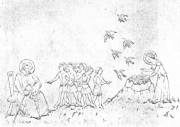
clay birds


And (appoint him) a messenger to the Children of Israel, (with this message): "'I have come to you, with a Sign from your Lord, in that I make for you out of clay, as it were, the figure of a bird, and breathe into it, and it becomes a bird by Allah's leave: And I heal those born blind, and the lepers, and I quicken the dead, by Allah's leave; and I declare to you what ye eat, and what ye store in your houses. Surely therein is a Sign for you if ye did believe; (Quran 3:49)


1 1 When the boy Jesus was five years old, he was playing at the ford of a rushing stream. And he gathered the disturbed water into pools and made them pure and excellent, commanding them by the character of his word alone and not by means of a deed.
2 Then, taking soft clay from the mud, he formed twelve sparrows. It was the Sabbath when he did these things, and many children were with him.
3 And a certain Jew, seeing the boy Jesus with the other children doing these things, went to his father Joseph and falsely accused the boy Jesus, saying that, on the Sabbath he made clay, which is not lawful, and fashioned twelve sparrows.
4 And Joseph came and rebuked him, saying, “Why are you doing these things on the Sabbath?” But Jesus, clapping his hands,  commanded the birds with a shout in front of everyone and said, “Go, take flight, and remember me, living ones.” And the sparrows, taking flight, went away squawking.

- The Infancy Gospel of Thomas


One of the interesting differences between the Quran and the mainstream Bible is the story of Jesus (as) animating clay birds as a child. The story does not exist in Matthew, Mark , Luke or John but it is found in the Infancy Gospel of Thomas and also the Arabic Infancy Gospel. So from a Muslim perspective should the later texts be considered as potential places where revelation might be found? Do they contain fragments of the Injeel? Another interesting question: where there Christians in the milieu of the early Muslims who treated either of these texts as scripture?

Allahu alim.


Early Christian Writings:
Infancy Gospel of Thomas

Saturday, November 20, 2021

one soul

" On that account: We ordained for the Children of Israel that if any one slew a person - unless it be for murder or for spreading mischief in the land - it would be as if he slew the whole people: and if any one saved a life, it would be as if he saved the life of the whole people." (Quran 5:32)

“Whoever destroys a soul, it is considered as if he destroyed an entire world. And whoever saves a life, it is considered as if he saved an entire world”. (Mishnah Sanhedrin 4:5; Yerushalmi Talmud 4:9)

I've been thinking a lot about how Christian evangelicals tend to grossly oversimplify the question of which earlier texts are "endorsed" by the Quran. The above is an interesting data point. The Bible doesn't have a passage which sounds like either of the two passages quoted above. So this seems to suggest that the Talmud might contain actual revelation. Christians tend to dismiss the Talmud altogether but for Jews there is a Written Torah (the Pentateuch) and an Oral Torah (which was ultimately codified and written down in the Talmud). Both are thought to be part of the revelation which was given to Moses (as) at Sinai. So the fact that the Quran is arguably affirming part of the Talmud, suggests that Islam has a much more complex relation with the scriptures of the People of the Book. Allahu alim.