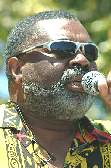
The starting point for Muslim American literature is Marvin X.
--Mohja Kahf, Professor of English and Islamic Studies, University of Arkansas
The most important African American Muslim poet in the United States.
--Julius E. Thompson, African American Review
I'd seen Marvin X's name (who also goes by Maalik El Muhajir) pop up in a few poetry anthologies but it wasn't till now that I could find out much about him or get a sense of where he was coming from. A lot of his focus has been working on poetry and theatre projects as a part of the Black Arts movement in California, where he achieved a certain degree of prominence. But he has certainly not just a local figure. His poetry has even appeared on Al-Jazeera
Some of his religious perspectives are more explicit in the poem "What if there was no God but God" and in the outline for a project called "Toward A Radical Spirituality" Both are available here along with a large sample of some of his other works.
......
Obviously, Marvin X came to identify as "Muslim" through the Nation of Islam, but it isn't clear to me where he stands now in terms of certain problematic doctrines. It brings up the whole general issue of what is the best way to think of the Nation of Islam and the people who went through that experience.
It is clear that there are a large numbers of American Sunni Muslims today who wouldn't be Muslim at all if it weren't for the direct or indirect actions of the Nation of Islam. Some actually became members of the Nation, and held on when W.D. Muhammad reformed the organization more towards orthodoxy. Others were never members, but were intrigued by the charisma of individuals like Malcolm X or Farrakhan, but then on futher investigation, found their way into the fold. But either way, that was the means Allah chose to bring Islam to a huge section of the ummah in America. So instead of demonizing the group categorically, or giving them nasty nicknames like the Nation of Kuffarrakhan or alienating them in other ways, it makes more sense to think of them as a valuable and perhaps necessary transition point. Arethey where they should be in terms of correct belief? Probably not. But you don't win hearts over by insulting them.
Although there are still issues of concern, Farrakhan has been encouraging his followers to follow the pillars in a more orthodox fashion. And in recent years there have been some moves towards reconciliation between the Nation of Islam under Farrakhan (there are actually multiple organizations who use the name) and the more orthodox W.D. Muhammad. On top of that, I've known a "card-carrying" member of the Nation of Islam who has told me that they never believed that Fard was Allah (in spite of what other members might believe) This isn't to say that the Nation of Islam are Ahl al-Sunnah wal Jamaat (in the sense of following one of the four Sunni schools in matters of fiqh, and either the Ashari or Maturidi schools in matters of aqueeda). But orthodox or not, I'm only suggesting that members of the organization can be Muslim.
Monday, May 21, 2007
ReplyDeleteMarvin X Marches Into Harlem, 39 Years Later
After 39 years since a public appearance in Harlem,
Marvin X returned to celebrate the birthday of Malcolm
X this past Saturday, May 19, 2007. He gotoff the A
train at 8th Ave. and 125th Street, and
before he knew it was caught up in the annual march
to shut down 125th Street in honor of Harlem's
greatest son, Malcolm X, organized by the December
12th Movement. But march he did, waving the red black
and green flag along with other protesters
who were accompanied by New York's finest. And the
march was 99% successful as merchants shuttered their
businesses from 1 to 4pm.
After an hour up and down 125th Street, Marvin
departed from the march at 125th and Malcolm X Blvd.
(Lenox Ave.) and headed to the Schomburg Library to
participate in a panel discussion of Malcolm X as a
writer. The panel was organized by activist Sam
Anderson and the Malcolm X Museum Trustees. The event
began with a video message from Maya Angelou, a
long-time friend of Malcolm and Betty Shabazz. She
read from a letter she had received from Malcolm
before his tragic death. The letter revealed his humor
and sense of urgency that was his style.
After a recitation of Sura Al Fatihah by brother Amir,
libation by Camille Yarbrough and greetings by Sister
Aisha Al Adawiya of the Schomburg and the Malcolm X
Museum, panelist were seated: Johanna Fernandez,
Cheryll Greene, Ester Iverem, Ewuare Osayande, Kevin
Powell, Askia Toure, Camille Yarbrough and Marvin X.
Moderator was journalist, author Herb Boyd.
The first round was introductions but realizing time
was limited, some panelists decided to expound on
Malcolm X as writer/activist. They told how Malcolm
influenced them and others in the liberation
struggle or as writers in general. Since all the
panelist were writers, I will let them give their
report in their words.
After the first round, there was only time for
three-minute closing remarks. The following is a
summary of my remarks: We must put Malcolm X in the
context of history, after all, he didn't jump out
of a box but was part of a radical tradition. We can
understand him by examining the writings of David
Walker in his Appeal, 1829, Henry Highland Garnett,
Martin Delaney and other radical writer/activists
from the 19th century. Further, we must study the
slave narratives, especially the Muslim slave
narratives because, after all, Malcolm was a
Muslim, so we must see him for the Islamic literary
tradition. His biography was yet another Muslim slave
narrative--on the theme of how I got ovah. Of course
his autobiography may be considered the
foundation of what is now being studied in academia as
the genre of Muslim American literature, although
black scholars have been sleeping on this genre
because of their Islamic bias, even though Muslim
American literature begins with North American
Africans as Dr. Mojah Kahf has declared, a professor
of English and Islamic literature at the University of
Arkansas. And further, we must place Malcolm X in line
with his immediate predecessors Marcus Garvey, Nobl
Drew Ali, Master Fard Muhammad and Elijah Muhammad. We must
understand that what happened between Elijah and
Malcolm was classic revolutionary activity. In
revolution shit happens, people are betrayed,
assassinated, there is jealousy and envy. We must
learn from these happenings, reconcile when possible
and continue the struggle. And finally, Malcolm in
particular and Islam in general had a great
influence on the Black Arts Movement. As Sonia Sanchez
has said, "We were all influenced by Malcolm and
Islam." This includes Askia Toure,Yusef, Iman, Amiri
Baraka, Larry Neal, Henry Dumas, Haki Madhubuti, Last
Poets, Barbara Ann Teer, Nikki Giovanni, Sun Ra,
Marvin X and others.
My "three minutes" ended with a reply to panelist
Amir, Kevin Powell and Ewuare Osayande who raised the
issue of white supremacy. I noted that I am presently
writing a book on How To Recover from the
Addiction to White Supremacy: A Pan African 12 Step
Model. There was audience laughter and applause when
I said the steps include detox, recovery and
discovery. Discovery is for those who have no
consciousness and must become aware then join the
cultural revolution.
To read excerpts from his latest manuscript How To Recover from the Addiction to White Supremacy, please go to:http://www.marvinxwrites.blogspot.com
View marvinx@youtube.com.
Monday, May 21, 2007
ReplyDeleteMarvin X Marches Into Harlem, 39 Years Later
Marvin X Marches Into Harlem, 39 Years Later
After 39 years since a public appearance inHarlem,
Marvin X returned to celebrate the birthday of Malcolm
X this past Saturday, May 19, 2007. He gotoff the A
train at 8th Ave. and 125th Street, and
before he knew it was caught up in the annual march
to shut down 125th Street in honor of Harlem's
greatest son, Malcolm X, organized by the December
12th Movement. But march he did, waving the red black
and green flag along with other protesters
who were accompanied by New York's finest. And the
march was 99% successful as merchants shuttered their
businesses from 1 to 4pm.
After an hour up and down 125th Street, Marvin
departed from the march at 125th and Malcolm X Blvd.
(Lenox Ave.) and headed to the Schomburg Library to
participate in a panel discussion of Malcolm X as a
writer. The panel was organized by activist Sam
Anderson and the Malcolm X Museum Trustees. The event
began with a video message from Maya Angelou, a
long-time friend of Malcolm and Betty Shabazz. She
read from a letter she had received from Malcolm
before his tragic death. The letter revealed his humor
and sense of urgency that was his style.
After a recitation of Sura Al Fatihah by brother Amir,
libation by Camille Yarbrough and greetings by Sister
Aisha Al Adawiya of the Schomburg and the Malcolm X
Museum, panelist were seated: Johanna Fernandez,
Cheryll Greene, Ester Iverem, Ewuare Osayande, Kevin
Powell, Askia Toure, Camille Yarbrough and Marvin X.
Moderator was journalist, author Herb Boyd.
The first round was introductions but realizing time
was limited, some panelists decided to expound on
Malcolm X as writer/activist. They told how Malcolm
influenced them and others in the liberation
struggle or as writers in general. Since all the
panelist were writers, I will let them give their
report in their words.
After the first round, there was only time for
three-minute closing remarks. The following is a
summary of my remarks: We must put Malcolm X in the
context of history, after all, he didn't jump out
of a box but was part of a radical tradition. We can
understand him by examining the writings of David
Walker in his Appeal, 1829, Henry Highland Garnett,
Martin Delaney and other radical writer/activists
from the 19th century. Further, we must study the
slave narratives, especially the Muslim slave
narratives because, after all, Malcolm was a
Muslim, so we must see him for the Islamic literary
tradition. His biography was yet another Muslim slave
narrative--on the theme of how I got ovah. Of course
his autobiography may be considered the
foundation of what is now being studied in academia as
the genre of Muslim American literature, although
black scholars have been sleeping on this genre
because of their Islamic bias, even though Muslim
American literature begins with North American
Africans as Dr. Mojah Kahf has declared, a professor
of English and Islamic literature at the University of
Arkansas. And further, we must place Malcolm X in line
with his immediate predecessors Marcus Garvey, Nobl
Drew Ali, Master Fard Muhammad and Elijah Muhammad. We must
understand that what happened between Elijah and
Malcolm was classic revolutionary activity. In
revolution shit happens, people are betrayed,
assassinated, there is jealousy and envy. We must
learn from these happenings, reconcile when possible
and continue the struggle. And finally, Malcolm in
particular and Islam in general had a great
influence on the Black Arts Movement. As Sonia Sanchez
has said, "We were all influenced by Malcolm and
Islam." This includes Askia Toure,Yusef, Iman, Amiri
Baraka, Larry Neal, Henry Dumas, Haki Madhubuti, Last
Poets, Barbara Ann Teer, Nikki Giovanni, Sun Ra,
Marvin X and others.
My "three minutes" ended with a reply to panelist
Amir, Kevin Powell and Ewuare Osayande who raised the
issue of white supremacy. I noted that I am presently
writing a book on How To Recover from the
Addiction to White Supremacy: A Pan African 12 Step
Model. There was audience laughter and applause when
I said the steps include detox, recovery and
discovery. Discovery is for those who have no
consciousness and must become aware then join the
cultural revolution.
Read excerpts from the manuscript in progress: How to Recover from the Addiction to
White Supremacy: http://www.marvinxwrites.blogspot.com
View marvinx@youtube.com.